Get Nebraska Mini Split

Best mini split setting for a Nebraska winter

A white wall-mounted mini-split air conditioner indoor unit centered against a plain light gray background.
I'm done searching

What temperature should I set my mini split to in winter?

Gas heat runs most furnaces in Nebraska, but if you've got a mini split handling a room or an addition, you want to know where to leave the dial once it gets cold. Set it wrong and you're either cold or paying for heat you don't need. With power cheap here, running it right matters more than running it cheap.

Set it between 68 and 70 degrees and leave it there

A mini split holds a steady setting better than it recovers from big swings. Picking 68 to 70 and leaving it alone lets the unit run at a steady, lower output instead of working hard to climb back up every time you bump the dial. Turning it down overnight or while you're out sounds like it saves money, but on a single-zone unit in a Nebraska winter, the system often ends up drawing more power to catch back up than it would have just holding steady. If the room still feels cold at 70, that's usually not a setting problem. It points to the unit being undersized for the space or something off with the system itself.

A white wall-mounted mini-split air conditioner near the ceiling of a room with plain beige walls and a pale curtain at the left edge.

Why the low setting struggles below freezing

A mini split pulls heat from the outside air, even when that air is cold. As the temperature outside drops toward zero, the unit has to work harder to pull out the same amount of heat. Most units still perform fine through a Nebraska cold snap, but setting the dial too low makes the outdoor coil run longer on each cycle, and ice can build up on it faster than the defrost cycle clears it.

A white wall-mounted mini-split air conditioner indoor unit installed near the ceiling on a plain off-white interior wall.

What a frosted coil means for you

If you walk outside and see frost or ice coating the outdoor unit, that's the coil losing its ability to pull in heat. The system will defrost itself on a timer, but a coil that's working against heavy frost most of the day is pulling more power to do the same job. A contractor who services mini splits every winter in this area can tell you if your defrost cycle and sensor are working the way they should before the next cold stretch.

Hold steady or let it drop

Keep it running low all day

  • The unit holds the room at a steady temperature instead of pulling it back up from cold every few hours.
  • The compressor stays at a lower, steadier output, which puts less strain on it than repeated cold starts.
  • If the room is one you use in the evenings, it's already warm when you get there.
  • On nights near zero, the unit still has to work to hold that setting, so you won't see it coast.

Let it drop when you're out

  • You're not heating a room nobody's in for the hours you're at work or asleep elsewhere.
  • Gas heat is covering the rest of the house anyway, so the mini split only has to catch up one room.
  • Recovery takes longer on a cold Nebraska night than it would in October, since the unit is starting further behind.
  • Cycling off and back on repeatedly asks more of the compressor than holding steady does.
A smiling bearded man in a dark green hooded jacket and blue t-shirt sits on a couch in a living room with shelves, a potted plant, and a bowl of popcorn on a wooden table.
A smiling man in a green long-sleeved shirt sits on a beige sofa in a living room, with a bowl of popcorn in the foreground, a large potted plant and shelving behind him.
A smiling man in a dark blue T-shirt sits on a couch in a dimly lit living room with a bowl of popcorn and a remote on a wooden table, a lit floor lamp and bookshelves behind him, and windows showing greenery.
A smiling bearded man in a dark green long-sleeved shirt sits on a leather couch in a living room, with a bowl of popcorn and a remote control on a wooden table in the foreground.

Power costs 12.05 cents per kilowatt-hour statewide

At 12.05 cents a kilowatt-hour, running your mini split steady through a cold snap won't hit your bill the way it would in a state with pricier power. That's worth knowing if you've been nursing the dial out of habit rather than comfort. Let it hold a steady temperature instead.

EIA-861 2025 statewide residential average

What a bad setting looks like at home

Leave the dial too low and the room it's heating never quite feels warm. You'll notice it most in the morning, reaching for a sweater in a room that's supposed to be the warm one. Set it too high and the outdoor unit runs long stretches without a break when it's near zero outside, which is exactly when a weak part is most likely to quit. Either way you tend to notice the mini split before you notice the furnace, because it's heating the one room you're sitting in. A unit that cycles hard in the cold is also a unit worth having looked at before the next cold snap, not after it stops.

What a checkup catches before winter

A local contractor who services mini splits every winter knows which parts tend to give out when a unit runs hard in the cold, and a maintenance visit checks those before you're relying on the unit during a stretch near zero. That means the coil, the line set connections, and the drain are looked at while it's easy to fix, not after you're sitting in a cold room waiting. Since it's one contractor and not several, you're not fielding calls all week trying to sort out who to let in. Once you send the request, finding that person stops being something you have to chase down yourself.

A woman in a dark gray sweater reclines on a light sofa with eyes closed and a slight smile, under a textured gray blanket with an open book resting on her lap, with a lit table lamp and plant in the background.
A smiling bearded man in a navy crewneck sweater sits at a dinner table with a glass of red wine, plates and glasses in the foreground, in a dimly lit room with a lamp and framed picture behind him.

Done looking for a mini split pro

A mini split that's never been serviced will start losing ground exactly when a Nebraska cold snap asks the most of it. The outdoor coil collects dust and the refrigerant charge drifts low, and the setting you dial in stops mattering much once the unit can't pull the heat it's rated for. You won't always hear a problem coming. Sometimes it just runs longer and longer to hold the same room at the same number. A local contractor who services these units every winter knows which parts fail first in this cold and checks them before they strand you on a hard night. Sending the request puts one contractor on it, someone who works this equipment in this climate all season, rather than leaving you to sort through strangers while the room keeps losing heat. Once it's sent, finding that person stops being something you have to do yourself.

  1. The indoor unit's thermostat senses the room is below your set point.

  2. The outdoor compressor starts and pulls heat from the outside air.

  3. Refrigerant carries that heat inside through the copper line set.

  4. The indoor coil releases the heat and the fan pushes it into the room.

A white wall-mounted mini-split air conditioner on a light gray wall in an empty room with dark wood flooring, white baseboards, a tray ceiling with recessed lights, and a window at the left.
A clean coil and a clear vent let the unit hold its set point without straining to get there.
A wall-mounted mini-split air conditioner indoor unit with a yellowed plastic casing and dark horizontal vent louvers, installed on a plain light-gray wall.
Dust on the coil and grime around the vents make the unit work harder for the same warmth, no matter the setting.
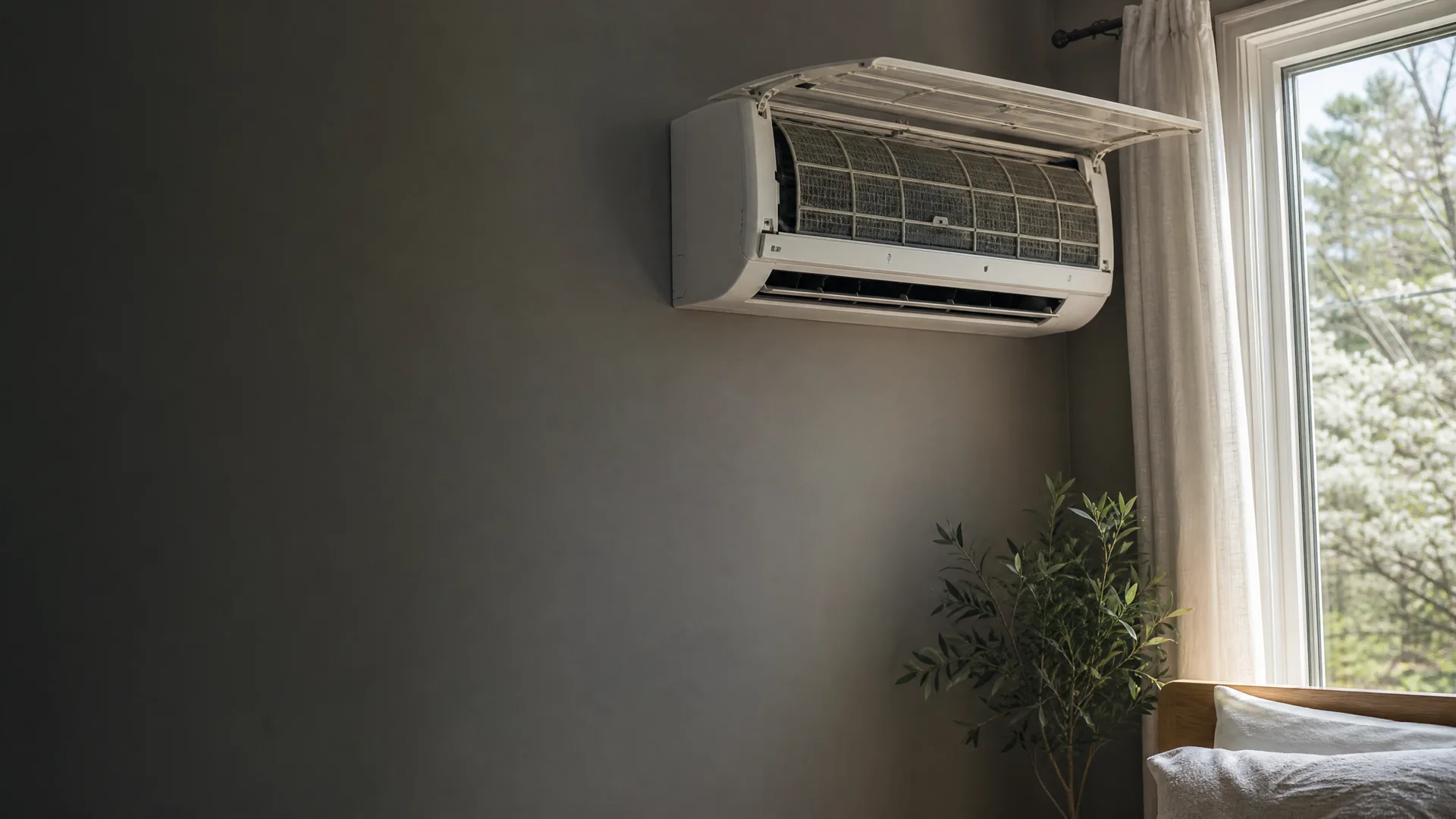
A wall-mounted mini-split air conditioner with its front cover open exposing the filters, on a gray interior wall beside a curtained window with green trees outside and a potted plant below.

It's a warm afternoon in April, sun coming in through the bedroom window. You finally pulled the cover off the indoor unit to see why the corner of the room never quite warmed up all winter. The filter screen behind it is grey with dust, thick enough that you can't see through the mesh. You'd kept nudging the dial higher those cold mornings, wondering why it never caught up. Now you're crouched by the unit with the cover propped open, filter in hand, thinking about the nights you sat under a blanket instead of turning it up again. Outside, it's warm enough that none of this matters for months, but you're already thinking about next winter and whether a clean filter would have made the difference.
Why does that one room still feel cold?

You've got the dial set where it's always been and the room still isn't holding. The unit runs more than it used to, and you can hear the outdoor fan kick on and stay on longer than it should for how cold it actually is outside. Maybe there's a faint musty smell when the air first kicks on, or a corner of the room that never quite catches up even with the unit running. That's not always a bad setting. A unit working that hard through a stretch of cold weather, without having been looked at, is putting more hours on the compressor than it needs to, and a compressor that strains all winter is the one that quits on you by February.

A white wall-mounted mini-split air conditioner unit installed high on a light gray interior wall below crown molding, with a bamboo-shaded window at the lower left.

What a clean unit looks like running

This is the indoor unit doing its job. Air moves through the vanes at the bottom and the casing stays white. No dust built up around the vents, nothing blocking the airflow. The room holds the temperature you set without the unit working any harder than it has to.

A wall-mounted mini-split air conditioner indoor unit with a dusty, discolored cover, installed near the ceiling on a plain light-colored wall.

What a neglected unit looks like

Dust has settled into the plastic casing and the louvers are coated with it. Grime like this builds up around the vents over a few winters without servicing. Air has to push through that buildup to reach the room, and the unit runs longer to hold the same set point.

A wall-mounted mini-split air conditioner indoor unit with a dusty off-white casing and dark lower vent, installed high on a plain light-colored wall below a ceiling molding.
Before you get your mini split maintenance
A white wall-mounted mini-split air conditioner installed high on a beige interior wall below crown molding, with a window and light curtain on a black rod at right.
After you get your mini split maintenance
A two-story house with gray and light gray siding, white-trimmed windows and a white front door, flanked by deciduous trees, with a partly browned lawn in front under a clear blue sky.

Summers here run sticky, with the dew point averaging 61°F across June, July and August, according to NOAA climate data. That's the muggy air your mini split's indoor coil has to wring moisture out of before it can even start cooling the room. In winter the air dries out, and the load on the unit changes with it. The outdoor coil isn't pulling moisture out of frigid air the way the indoor coil did in July. It's pulling heat out of it, and that's a different job. A coil that spent the summer damp and collecting dust doesn't switch over clean for winter on its own.

NASA POWER T2MDEW county cells weighted by homes

A steady setting in the high 60s, held through the cold instead of pushed up and down, is what keeps a mini split working with a Nebraska winter instead of against it. The unit still needs to be able to hold that setting, and that comes down to a clean coil, a clear vent and a refrigerant charge that hasn't drifted low. A tech who works on these units all season in this area has seen what a Nebraska winter does to the outdoor coil and knows which part tends to go first. Getting matched with one local contractor means the person who shows up is the one who looks at your unit, not a dispatcher routing you to whoever's free. No flood of calls from competing companies, just the one call back from someone who services this equipment through the cold months and knows what to check first. The dial does its part. The unit has to be able to answer it.

A white wall-mounted mini-split air conditioner on a dark grey textured wall, with a monstera plant leaf at the lower right corner.

It's off your list after this

Step 1 of 3: Equipment