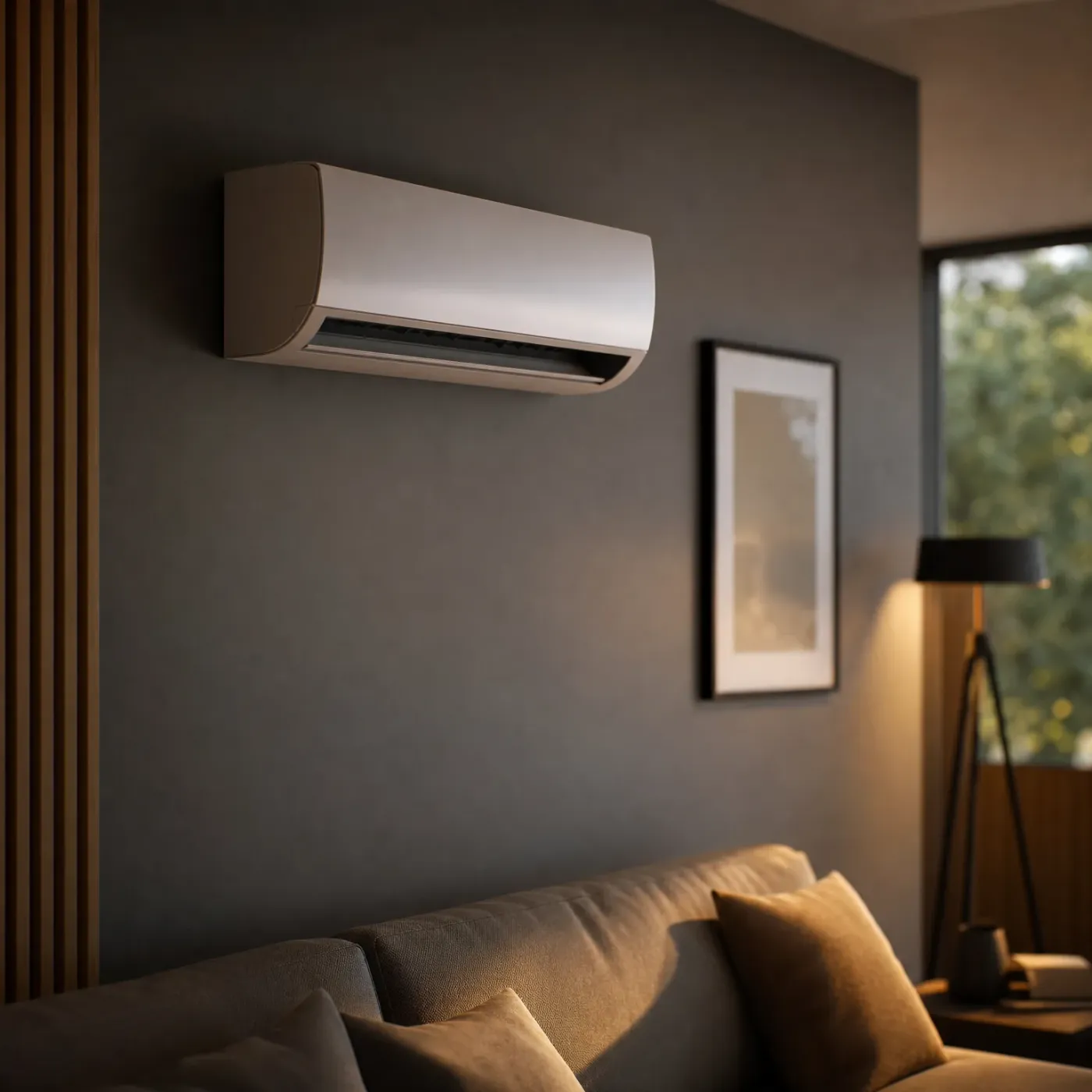












A white wall-mounted mini-split indoor unit on a gray interior wall above a beige sofa, with a framed picture, a floor lamp, wood slat wall trim, and a window showing green foliage.

Send one request and you're done looking

Can a mini split be your only heat in Nebraska

A mini split can heat a Nebraska house on its own, but whether it should carry your winter depends on the unit's rating and how cold it gets where you live. Below this, find out what that takes, and skip the work of tracking down a contractor to check your setup.

Hand it off

A mini split can be your only heat in Nebraska, but most homes here lean on it as backup to a gas furnace, and there's a reason for that. Below a certain outdoor temperature, a standard heat pump's output drops and it has to run constantly just to hold the house at setpoint. A cold-climate mini split, rated for sub-zero operation, holds up through most of a Nebraska winter. The question is what happens on the coldest nights, the ones well below zero, when even a cold-climate unit's capacity thins out. If you're planning to go mini split only, that rating is what decides whether your living room stays warm in January or you're layering up waiting on a repair call. Sizing and placement matter just as much as the rating on the box.

A white wall-mounted mini-split air conditioner unit installed high on a plain beige wall near the ceiling, with empty wall space to the right.

Cold climate units hold up longer

A standard heat pump starts losing capacity around freezing and keeps dropping from there. A cold climate mini split is built differently, with a compressor that ramps up harder in the cold instead of stalling out. Some are rated to keep producing useful heat down to 5 degrees or lower. That rating is the number to check before leaning on one through a Nebraska January, since the gap between a standard and a cold climate unit shows up exactly when you need the heat most.

A white wall-mounted mini-split air conditioner indoor unit on a plain light-colored wall, with a beige curtain at the right edge of the frame.

What happens below the rated point

Once the outdoor temperature drops below a unit's rated capacity, it doesn't shut off. It keeps running, but it can't move enough heat to keep up with the house losing it. The indoor temperature drifts down a degree or two and the system runs nearly nonstop trying to close the gap. That's the point where a backup source, gas furnace or electric resistance strip, needs to pick up the difference rather than leaving the mini split to struggle alone.

Power costs 12.05 cents per kilowatt-hour statewide

At 12.05 cents a kilowatt-hour, running a mini split through a Nebraska winter costs less per hour than most people expect. That's part of why a cold climate unit can carry a house on its own instead of just backing up the furnace, if it's sized and installed for your coldest days.

EIA-861 2025 statewide residential average

A gas furnace doesn't care how cold it gets outside. It fires the same way at 20 below as it does at 20 above, and it was likely sized to cover the coldest night your part of Nebraska sees.

A mini split's output shrinks as the temperature drops, so the furnace is what keeps your house warm on the nights a standard unit would fall behind. That's the case for keeping it as backup even after a mini split goes in.

A dusty, discolored white wall-mounted mini-split air conditioner unit installed on a plain beige interior wall below a molding strip.
Before you get your mini split installation
A white wall-mounted mini-split air conditioner installed high on a light gray interior wall below a white crown molding and ceiling with a recessed light.
After you get your mini split installation

A heat pump doesn't burn anything to make heat. It pulls heat out of the outside air and moves it into the house, which is why the compressor has to work harder as the temperature drops outside. A standard unit starts losing ground well before zero. A cold climate model is built with a variable speed compressor that can push past its normal range for a stretch, which is what lets it keep producing heat through a cold snap instead of stalling. Most of these units are rated to keep putting out meaningful heat down to around negative 15 degrees Fahrenheit. Past that point, the unit keeps running, but it can't move heat as fast as the house is losing it. Every cold climate mini split comes with a published rating that shows exactly how much heat it delivers at specific outdoor temperatures. That number, matched against how cold it actually gets where you live, is what tells you whether the unit can carry your house through winter on its own or needs a furnace behind it.

How a cold climate unit keeps up

  • A heat pump moves heat from outside air into the house instead of burning fuel to create it.
  • The compressor has to work harder as the outdoor temperature drops, which is why output falls off in the cold.
  • A cold climate model uses a variable speed compressor that can ramp past its normal range for short stretches to cover a cold snap.
  • Most cold climate units are rated to keep producing meaningful heat down to around negative 15 degrees Fahrenheit.
  • Below that rated point, the unit can still run, but it won't keep up with how fast the house loses heat.
  • Every cold climate mini split has a published rating showing how much heat it puts out at specific outdoor temperatures, and that rating is what decides whether it can carry your house alone.
A white wall-mounted mini-split air conditioner on a beige interior wall, with a cream curtain and window at left, a potted plant on a ledge at right, and a wood floor below.
A mini split that's kept clean and sized right for the room keeps its output through a Nebraska winter.
A dusty, discolored white wall-mounted mini-split air conditioner unit installed high on a plain interior wall below a white ceiling molding.
Dust packed into the coil and vents makes it work harder for less heat, right when you need it most.
  1. Outdoor air passes over the unit's cold refrigerant coil outside.

  2. Refrigerant absorbs heat from that air, even when it's cold.

  3. The compressor squeezes the refrigerant, raising its temperature further.

  4. Hot refrigerant flows inside, and the indoor coil releases that heat.

Is your mini split keeping up on the coldest nights

You notice it most around 2 or 3 in the morning, when the house has had hours to cool and the unit hasn't let up. The air coming out feels cooler than it should, the outdoor fan is running flat out, and the room still isn't holding the temperature you set. Maybe you're reaching for a space heater in the bedroom farthest from the indoor unit, or you've started layering blankets instead of turning up the dial. If the unit is a standard model and it's the only heat in the house, this is what happens below freezing, and on the coldest nights it can mean the house keeps losing ground no matter what the thermostat says.

A man in a blue sweatshirt reclines with closed eyes in a brown leather armchair in a living room with a bookshelf, houseplant, sofa, window, and a side table holding newspapers and a dark mug.
A bearded man in a gray pullover reclines with closed eyes on a brown leather sofa in a sunlit room with a window, framed picture, potted plant, and a wooden cabinet holding papers and a dark mug.
A man in a gray sweater leans back with closed eyes in a brown leather armchair beside a wooden side table holding a dark mug and a folded newspaper, with bookshelves and a window seat behind him.
A man in a green sweater reclines in an armchair with his eyes closed and a slight smile, beside a window with plants, a small table holding a mug and folded newspaper, and bookshelves behind him.

Finding a pro stops being your job

You've read what a cold climate mini split can do and what it takes for one to cover your whole winter instead of just riding alongside the furnace. Figuring out whether your unit, your house and your part of Nebraska line up for that is a job for someone who can look at the specs and the room, not a guess from a search page. Left on your own, that means calling around to installers, explaining your setup to each one, waiting on quotes, and sorting through answers that don't agree. Send the request instead and that work is off your plate. One contractor who installs these units takes it from here, and you go back to deciding what to do with your winter, not who to call about it.

A white wall-mounted mini-split air conditioner near the ceiling of a room with light gray walls, white crown molding, and a beige curtain at the left edge.

Clean and keeping up

A mini split with a clear coil and clean filter pulls heat out of cold air the way it's supposed to. Airflow stays strong, the outdoor fan doesn't have to strain, and the unit holds its output on a hard January night instead of losing ground.


A dusty beige wall-mounted mini-split air conditioner indoor unit installed high on a plain light-colored wall below the ceiling.

Caked and falling behind

Dust packed into the coil and that staining on the wall above it mean the unit is working harder for less heat. In a Nebraska winter, that's the difference between a mini split that carries the house and one that quietly gives up when it's needed most.

A closed laptop and a cream mug of coffee on a coaster sit on a dark wooden table, with a potted plant at left and a kitchen counter, tiled backsplash and shelf of ceramics in the background.

What relying on it looks like in your house

If your mini split is undersized or standard rather than cold climate, you'll feel it in the rooms farthest from the indoor unit first. The bedroom down the hall stays a few degrees cooler than the living room, and on the coldest nights that gap gets wider instead of smaller. Your gas furnace, if you still have one, picks up the slack without you doing anything, which is exactly why most Nebraska homes keep it around instead of pulling it out.

What you don't want is to find out mid-January that your unit can't hold the house, after you've already leaned on it as your only source of heat. That's a cold house and a scramble to find someone who can look at the system, explain what's wrong, and tell you whether it's a sizing problem or a repair. Send the form instead and that search is done for you. No calling around, no repeating the story of your unit and your house to three different companies, no sorting through quotes on your own. Someone who installs these in Nebraska winters gets the details and reaches out.

A living room corner with a light beige sofa holding a textured taupe cushion, a large ceramic vase of olive branches by a window, a framed neutral artwork on the wall, and a dark bowl with stacked books in the foreground.
A two-story gray horizontal-siding house with multiple gables, a covered front porch with white columns and railing, and a dark front door, fronted by a patchy green and brown lawn under a clear blue sky.

Summer here isn't just hot, it's heavy. Homes in Nebraska average a 61°F dew point across June, July and August, according to NOAA climate data. That's sticky enough that your mini split spends those months pulling moisture out of the air as much as cooling it. A unit sized only for temperature can leave the house feeling damp even when the thermostat says it hit the mark. One that's sized right handles both jobs at once, which matters more in a Nebraska summer than the number on the dial.

NASA POWER T2MDEW county cells weighted by homes

An older man with gray hair and a beard leans back on a beige sofa with his eyes closed, in a sunlit room with potted plants, a wicker chair and large windows behind him.
A woman in a cream knit sweater sits in an armchair with her eyes closed and a slight smile, beside an open window showing orange autumn foliage, with a mug, books and a lit candle on a small side table.

So can it heat your house alone

  • A cold climate mini split sized for your house can carry a Nebraska winter on its own without a gas furnace backing it up.
  • A standard mini split loses too much output below freezing to be trusted as your only heat here.
  • The unit's cold climate rating and its sizing for your square footage decide the answer, not the brand name on it.
  • A clean coil and filter help the unit hold its output on the coldest nights, while a dirty one falls behind right when you need it most.
  • At roughly 12 cents a kilowatt-hour, running one through the winter costs less per hour than most people guess.
  • Checking whether your specific unit and house line up for that is a job for a contractor, not a guess from a spec sheet.

The answer comes down to two things: whether your mini split is a cold climate model, and whether it was sized for the square footage it's heating. Get both right and it can carry your house through a Nebraska winter without a gas furnace next to it doing the work on the coldest nights. Get either wrong and you end up with a unit that runs constantly below freezing and still falls short, which is why most homes here keep it paired with gas rather than betting the whole winter on it. None of that shows up on a spec sheet in a way you can just read off. It depends on how your house holds heat, where you are in the state, and what unit is actually mounted on your wall, and that's a harder thing to judge from a product listing than it sounds.

That's the part worth handing off instead of guessing at. Finding a contractor who'll actually look at your unit and your house, rather than just quote a number over the phone, usually means calling around, explaining the same thing to three or four companies, and sorting through quotes that don't line up with each other. Sending the form here skips that. It puts your situation in front of someone who installs these for a living, and from there it's their job to tell you where you stand, not yours to keep chasing an answer.

A white wall-mounted mini-split air conditioner on a dark gray interior wall, with a flat screen at lower left and a green leafy plant at lower right.

Let someone else find the pro

Step 1 of 3: Equipment




