Profile view of a bearded man wearing a dark green baseball cap and a dark gray T-shirt against a plain light background.

Can a mini split heat a basement in a Nebraska winter

Step 1 of 3: Equipment

Can a mini split heat a basement in a Nebraska winter?

A basement stays colder than the rest of the house, and a Nebraska winter is no small thing to heat against. If you're thinking about putting a mini split down there, or you already have one and it's struggling once temperatures drop into single digits, you want to know whether the unit can actually keep up or whether you're looking at a cold basement all winter.

A mini split can heat a basement here, but only if it's sized and installed for real cold

Most mini splits sold for this climate are rated to keep producing heat well below zero, so the cold itself isn't the problem. What matters is whether the unit has enough capacity for the basement's square footage and how much heat the space loses through the foundation walls. A basement that's partly below grade holds heat differently than a room upstairs, and an undersized unit will run constantly without keeping up once it's in the teens outside. Since most homes here heat with gas, a mini split in the basement is often doing a job the furnace doesn't reach well, and sizing it for the coldest nights, not an average one, is what decides whether it actually works.

A white wall-mounted mini-split indoor unit installed high on a gray interior wall, with a window at left and part of a light gray sofa with a dark cushion at lower right.

Properly sized and placed

A mini split that's sized for a Nebraska basement keeps pace on the coldest days, cycling steadily instead of running flat out. Set the indoor unit where it can throw air across the room, away from stairwells that pull heat back upstairs, and the space holds a steady temperature through January.


A white wall-mounted mini-split air conditioner indoor unit with visible dust and staining along its lower vent, installed on a plain pale wall.

Undersized or poorly placed

A unit that's too small for the basement, or mounted where the airflow gets blocked by a couch or a corner, falls behind once temperatures drop. It runs constantly without catching up, the vents collect dust and grime from the extra strain, and the basement stays noticeably colder than the rest of the house.

Mini split alone or backed by gas

Mini split alone

  • A cold-climate unit holds its rated output down to around 5 degrees, but below that its capacity falls off and recovery after a cold night takes longer.
  • The basement draws heat only from the one indoor head, so a finished room on the far side of the stairs or behind a wall may run several degrees cooler than where the unit sits.
  • During a hard freeze or an outage, nothing else in the basement is making heat, so the room cools as fast as it would with any other electric heat source.
  • Electric resistance backup inside the unit, if it has one, draws a lot more power than the compressor does, and that shows up on the bill during the coldest stretches.

Mini split plus gas heat

  • Most homes here already heat with a gas furnace, and a basement register or two tied into that system keeps the floor from going cold when the mini split is working hardest.
  • Gas heat doesn't lose capacity in a deep freeze the way a heat pump does, so it covers the basement on the nights the mini split would otherwise struggle.
  • Running the mini split for most of the winter and letting the furnace carry the coldest days keeps the compressor out of its weakest range.
  • With power cheap here, the mini split still handles the bulk of the season efficiently, while the furnace is there as backup rather than the main source.
A white wall-mounted mini-split air conditioner installed high on a light gray interior wall below a white crown molding and ceiling with a recessed light.

Sized right for the space

This is what a basement mini split should look like. The head sits high on the wall, clean and clear, pulling air in and pushing it back out across the room. At this size, for this basement, it keeps up with a Nebraska cold snap without strain.

A dusty, discolored white wall-mounted mini-split air conditioner unit installed on a plain beige interior wall below a molding strip.

Undersized or aging out

Dust and discoloration like this build up over years of running near its limit. A unit worked too hard for too long shows it on the casing before it shows up as a breakdown. If yours looks like this, it may be time for a size that matches your basement.

An older man with gray hair and a beard, wearing a dark coat dusted with snow, stands smiling in a doorway of a warmly lit home with a sofa, lamp and window visible behind him.
An older man with grey hair and a beard, wearing a dark coat dusted with snow, stands in a dimly lit entryway with a ceiling lamp, a side table with two shaded lamps, and a lit fireplace visible in a room beyond.
A bearded older man in a dark snow-dusted coat and scarf stands just inside a home's front door, with a lamp-lit room and snowy window visible behind him.
An older man with gray hair and a beard stands in a doorway of a home, wearing a dark coat dusted with snow, with a lit fireplace and lamp visible in the blurred room behind him.

Why basements lose heat fast

Basement walls sit against soil and concrete, and both pull warmth out of a room faster than framed walls upstairs do. A mini split has to work against that constant draw all day, not just on the coldest nights. That's part of why sizing matters more down there than it does on a main floor. A unit that's a size too small won't just run longer, it'll lose ground on a night when it gets into the single digits and never quite catch back up before morning.

What a cold-climate compressor does

A cold-climate mini split uses a compressor built to keep pulling heat from outside air even as that air gets thin on warmth. Below its rated point, usually somewhere around 5 degrees, it starts drawing on backup heat strips or whatever supplemental source is tied into the system. That's normal, not a sign anything's wrong. The compressor itself is the part doing the real work all winter, and it's the part worth asking about by name when you're comparing one unit against another for a Nebraska basement.

A woman wrapped in a thick cream knit blanket sits in an armchair beside a lit table lamp, with an open book in the foreground and a frost-covered window behind her.
A bearded man in a plaid flannel shirt stands indoors looking out a frost-covered window, with a steaming dark blue mug on the wooden sill and snow-covered trees outside.
A two-story cream-colored house with horizontal siding and a gray hipped roof, flanked by large green trees and shrubs, with a concrete walkway crossing a lawn to a wet street in the foreground.

Summer dew points here average 61°F across June, July and August, based on NOAA climate data for Nebraska. That's heavy, sticky air, the kind that sits on your skin. A mini split in the basement is pulling moisture out of that air as much as it's cooling it, and a basement already holds damp from the concrete and soil around it. You'll notice it in how the room feels, dry and even, not just cooler. Come winter, that same equipment has to reverse the job and push heat into a room the ground keeps pulling warmth from. Getting the sizing right for both jobs isn't something to guess at. A local installer who works basements in this area every season knows how a Nebraska summer and a Nebraska winter each load that unit differently, and sizes for both instead of just one.

NASA POWER T2MDEW county cells weighted by homes

Get the right pro for your mini split

One installer gets your project, so there's no bidding war over it.

No charge to send it. You decide if you hire them.

How a mini split actually heats

  • A mini split runs a refrigerant loop between the outdoor compressor and the indoor head, moving heat instead of generating it.
  • Below freezing, the outdoor unit shifts briefly into a defrost cycle, reversing flow to melt frost off its coil before going back to heating.
  • The indoor head's inverter compressor adjusts its speed continuously, slowing down once the basement holds its set temperature instead of shutting off completely.
  • Cold refrigerant gas gets compressed into a hot, high-pressure gas before it ever reaches the indoor coil and gives up that heat to the room.
  • A variable-speed blower inside the head ramps up during the coldest stretches and eases back once the space catches up, which is why it sounds different at 10 degrees than at 40.

A mini split doesn't make heat the way a furnace does. It moves heat from the outside air into your basement, even when it's cold out, by running refrigerant through a loop between the outdoor compressor and the indoor head. That refrigerant arrives at the indoor coil as a hot, high-pressure gas, and it gives that heat up to the room before cycling back outside to pick up more. The compressor is an inverter, so it isn't just on or off. It ramps up when the basement is cold and eases back once the room holds its set temperature, which is why the unit runs quieter on a mild afternoon than it does during a hard freeze. The blower inside the head works the same way, speeding up to push more air during the coldest stretches of a Nebraska night and slowing down once the space catches up. When outdoor temperatures drop below freezing, frost builds on the outdoor coil, and the system has to deal with it. It reverses the refrigerant flow for a few minutes, melts that frost off, then switches back to heating. You might notice the outdoor fan pause or steam come off the unit during this. That's normal operation, not a malfunction. None of this is a one-time blast of heat like a space heater. It's a steady, adjusting process built to keep pace with whatever the basement is losing to the cold ground and walls around it.

A white wall-mounted mini-split air conditioner on a beige interior wall, with a cream curtain and window at left, a potted plant on a ledge at right, and a wood floor below.
A clean unit moves heat the way it's rated to, and in a Nebraska basement in January that rating matters.
A dusty, discolored white wall-mounted mini-split air conditioner unit installed high on a plain interior wall below a white ceiling molding.
A unit caked in dust like this is losing capacity right when the basement needs all of it.

Power costs 12.05 cents per kilowatt-hour statewide

Nebraska homes paid 12.05 cents per kilowatt-hour in 2025, among the cheaper rates in the country. A mini split in the basement runs on electricity the whole time it's heating, so that low rate keeps it from competing with the gas furnace upstairs on cost the way it might somewhere with pricier power.

EIA-861 2025 statewide residential average

  1. The thermostat calls for heat and the compressor starts.

  2. Refrigerant absorbs heat from the outdoor air, even when it's cold.

  3. The compressor raises that refrigerant to a higher temperature.

  4. The indoor head blows across the hot coil and warms the basement.

A mini split sized and installed right can hold a Nebraska basement warm through January, running steady instead of straining against the cold. The sizing, the placement on the wall, the way it handles a hard freeze, all of that comes down to the install. Get matched with a local contractor who works on mini splits through every Nebraska winter and knows which basements give them trouble, whether it's a walkout that loses heat fast or a tight room with no airflow path to the stairs. You'll hear from one contractor, not a handful competing for your call, so the conversation stays about your basement and what it needs. That's the piece that decides whether the unit keeps up on the coldest night or falls behind it.

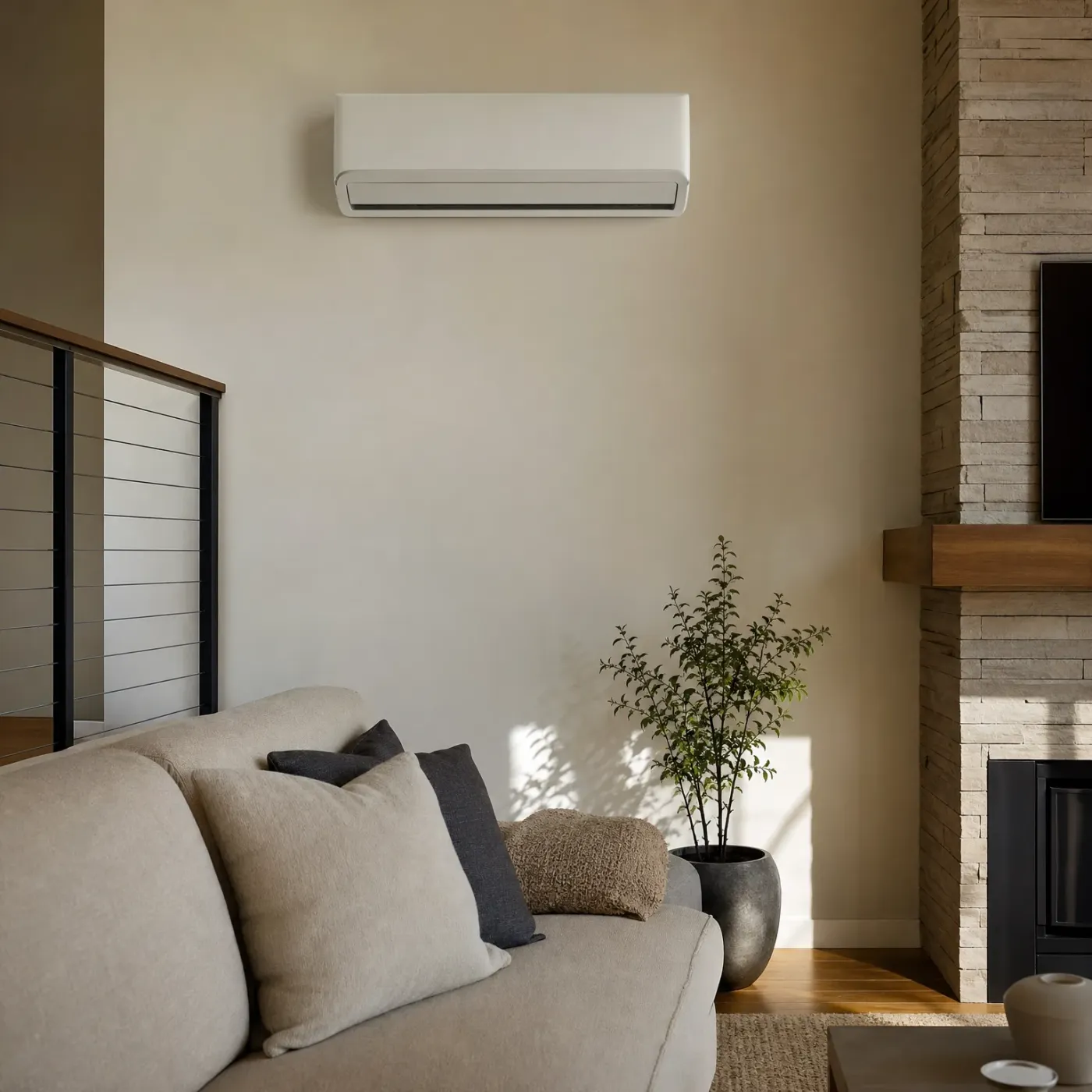
Interior living room with a white wall-mounted mini-split air conditioner high on a beige wall, a light gray sofa with cushions, a potted small tree, a stacked-stone fireplace with wood mantel and mounted TV, and a cable railing at left.

A pro who works on mini splits

Find a local pro

Only one pro gets your request, so you hear from one company.

There's no charge for the request.