How often to clean a mini split in Fremont, NE

Step 1 of 3: Equipment

Clean the filters on a mini split every two to four weeks when you're running it hard, and have the coils and blower wheel cleaned by a contractor once a year. The filters catch dust and pet hair right at the indoor unit, and in a house that's cooling or heating most of the day, that buildup packs in fast and blocks airflow across the coil. A blocked coil makes the system work harder to move the same amount of heat, and in Fremont that means both directions matter: the unit is pulling moisture out of sticky summer air and pushing heat into a house through a hard winter. A yearly cleaning gets into the coil fins and the blower wheel where dust settles out of reach of a filter rinse. Skip it for a few years and you'll likely notice the system running longer to hit the same temperature, and ice forming on the outdoor coil in cold weather is often a sign buildup has gotten ahead of you.

A white wall-mounted mini-split indoor unit on a light gray interior wall, with a white curtain on a black rod at left and a leafy plant in the lower left corner.

A clean unit keeps the air moving

A mini split that's wiped down and filtered on schedule pulls air through freely and puts out the temperature you set it to. The room cools or heats evenly, and the unit on your wall near that curtain stays quiet while it does it.

A wall-mounted white mini-split air conditioner indoor unit with visible dust and grime around its outlet vent, installed near the ceiling on a plain light-colored wall.

A dirty unit is working against you

Dust and grime caked along the vents and casing edges mean the unit is pulling air through buildup, not past it. It has to run longer to do the same job, and that grime is close to working its way back into the room you're sitting in.

How much does my mini split actually run each year?

  • Cooling runs June through September

    Cooling runs June through September. That's four months of the indoor filter pulling in dust, pollen and whatever the air conditioner can't keep out on its own.

  • Heat runs October through May

    Heat runs October through May. Eight months a year, double the cooling stretch, means the filter and coil are working most of the calendar.

  • Power here costs 12.41 cents per kilowatt-hour

    Power here runs 12.41 cents per kilowatt-hour. A mini split that's clogged works harder to hit the same temperature, and that shows up on the bill every month it runs.

NOAA nClimDiv 1991-2020 · EIA-861 2025

What's Actually Happening Inside the Unit

  • The indoor unit pulls air across a cold coil, and anything the filter misses settles right onto those fins.
  • A dirty coil can't transfer heat well, so the blower runs longer to reach the temperature on the thermostat.
  • The blower wheel has curved blades that trap dust and grease in a film you can't see from outside the housing.
  • A fouled blower wheel moves less air even at full speed, which is why some rooms stop feeling right.
  • The condensate drain line sits right under the coil, and coil grime is what usually clogs it first.
  • A clogged drain line backs up and drips from the indoor unit onto the wall or floor below it.

Warm room air gets pulled across a cold coil inside the indoor unit, and that's where the heat actually leaves the room. The filter sits in front of that coil to keep dust off it, but no filter catches everything, and what gets past settles right onto the fins. Once those fins carry a layer of dust, they can't pull heat out of the air as well, so the blower has to run longer to hit the temperature you set. Behind the coil is the blower wheel, a cylinder of curved blades that pushes air out into the room. Dust and grease build up in the curve of each blade, not on the surface you'd see if you popped the cover off, which is why a blower wheel can look fine and still be fouled. A fouled wheel moves less air even running at full speed, and that's usually why one room in the house never quite gets as cool or as warm as the rest. Below the coil runs the condensate drain line, carrying off the water that collects as the coil does its job. Coil grime doesn't stay on the coil. It washes down with that condensate and is what usually clogs the drain line first. Once the line is clogged, the water backs up with nowhere to go, and it finds its way out at the indoor unit, dripping down the wall or onto the floor underneath.

A wall-mounted mini-split air conditioner indoor unit with visible dust and staining, installed on a beige interior wall below white crown molding.
Before you get your mini split maintenance
A white wall-mounted mini-split indoor unit high on a beige interior wall, with a potted olive-like tree at right and an armchair and window visible through a doorway at left.
After you get your mini split maintenance

12 months of runtime a year

Most Fremont homes heat with gas, but the mini split still covers cooling and shoulder-season heat. That's dust moving through the filter nearly every month.

Skip calling around

One contractor, one visit

A local tech who services this equipment every season knows which coil or blower problem tends to show up first in a Dodge County winter, without you calling around to find out.

Skip calling around
A woman in a cream sweater with her hair in a bun laughs while seated at a stone counter holding a glass of red wine, in a dimly lit interior with a sofa, houseplants and a large window at night.
A woman with long dark hair in a cream knit sweater laughs while looking off to the side, seated in front of a dimly lit kitchen with an island, stools, open shelving and a potted plant, with a glass of red wine in the foreground.
A smiling woman with long dark wavy hair in a light knit sweater sits at a marble counter with a glass of red wine, with a dimly lit living room and kitchen in the background.
A smiling woman with long wavy brown hair in a beige sweater sits at a white marble counter with a glass of red wine, with a living room, dining table and kitchen cabinets behind her.

Describe it once

A licensed local pro takes the request for your mini split tune-up.

No fee to send it, and nothing to sign.

Skip it and here's what happens

Dust builds up on the filter first, and once it's packed in, air has to push through it instead of across it. The blower works harder to move the same amount of air, and your electric bill carries that difference even though gas heats the house most of the year. Keep skipping it and the coil behind the filter picks up what gets past it. A coil coated in dust can't pull heat out of the air well, so the unit runs longer to hit the temperature on your thermostat, and in a Fremont summer that's a lot of extra runtime.

Stay on top of it

Wipe down the filter every few weeks through a sticky Fremont summer and the unit keeps pulling air the way it was built to. The room gets to temperature and holds it instead of running on and on. You'll notice the wall unit stays quieter too, since a clean blower wheel doesn't have to fight dust stuck to its blades. Get the coil and blower cleaned once a year and the system is ready for whatever Dodge County weather asks of it next, whether that's a July heat wave or a January cold snap.

Cooling runs June through September

Four months of cooling means the filter is loaded with dust and pollen by the time September comes around. Check it monthly through that stretch, not just once at the start of summer, so the coil behind it stays clean and the unit keeps pulling its weight.

NOAA nClimDiv 1991-2020

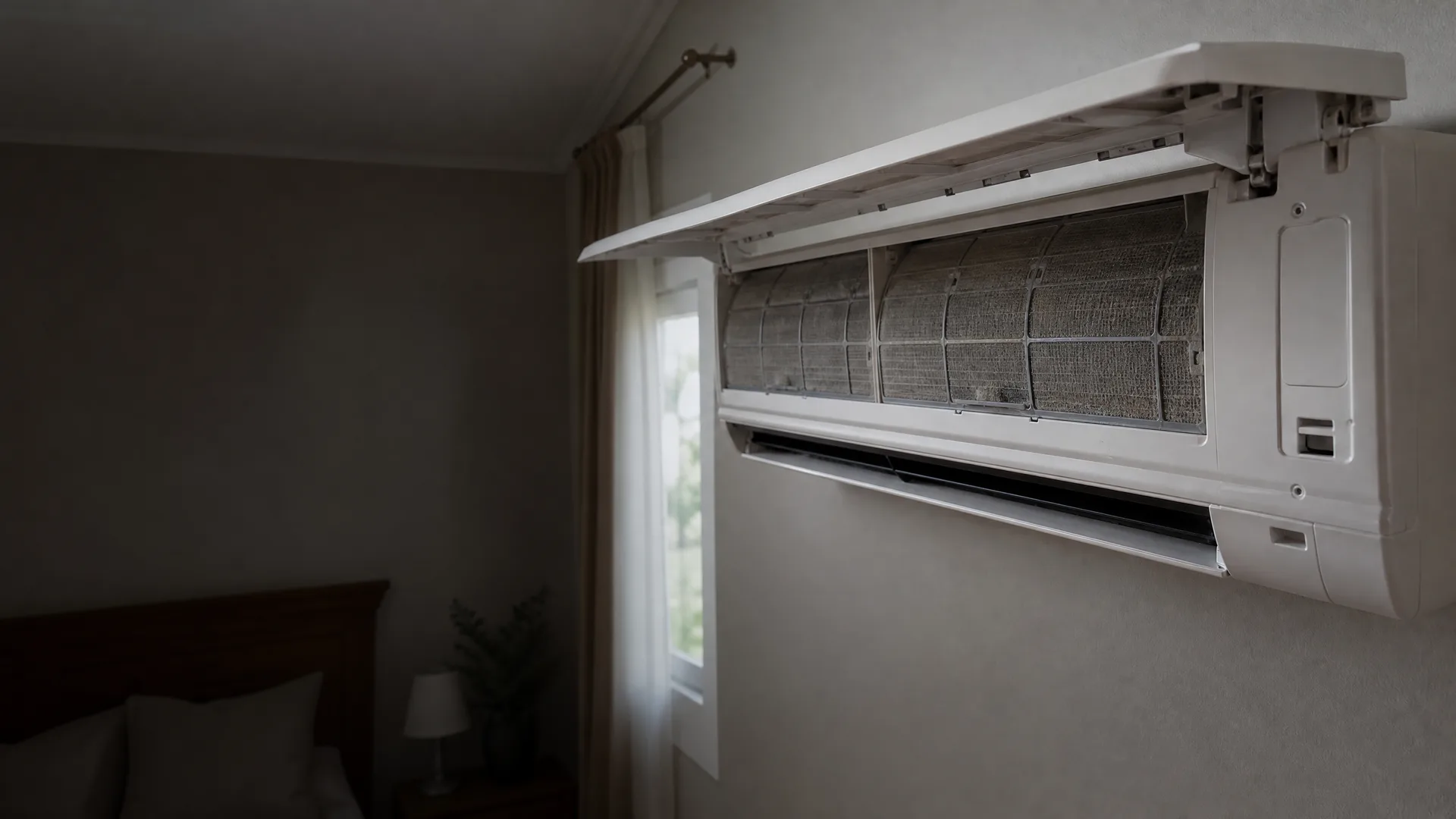
A wall-mounted mini-split air conditioner with its front cover open, exposing dusty filters and coil, in a dim bedroom with a window and bed headboard in the background.

It's a warm afternoon in late April, sun coming through the bedroom window in Fremont. You finally got around to pulling the cover off the mini split indoor unit, the one that's been running since the first sticky days hit. The filter screen slides out grey with dust, thicker than you expected for how new the unit still feels. You hold it up to the light and can barely see through the mesh. A few strands of pet hair are caught along one edge. You set it in the sink to rinse, thinking about the next four months of cooling ahead and how this is the easy part, the part you can do yourself before summer really settles in over Dodge County.

A closed laptop and a ceramic mug of dark coffee sit on a wooden table, with a blurred kitchen counter, potted plant, wooden utensils and cutting boards, and a large window in the background.

Filters every few weeks, a tech once a year

That's the whole answer. Wash or vacuum the filters every two to four weeks while the mini split is running hard, and get the coils and blower wheel cleaned by someone who works on this equipment once a year. Your unit runs nearly twelve months between gas heat in the cold months and cooling all summer, so the filter never really gets a break, and the yearly cleaning catches what the filter can't.

Finding someone to do that part doesn't have to mean calling around Dodge County, explaining the unit on your wall and its filter habits to three different companies, then weighing quotes against each other. One local contractor who already knows this equipment can take that cleaning off your list, and you're back to just wiping the filter screen yourself on your own schedule.

A light-colored ceramic vase holding green leafy branches sits on a round wooden table, with a wooden-framed armchair draped in a cream throw, a tripod floor lamp, and sheer curtains blurred in the background.
A smiling middle-aged man in a dark green sweater sits at a candlelit table with a glass of red wine and a bowl of salad in the foreground.
A woman in a cream knit sweater reclines on a beige couch with eyes closed and a slight smile, a gray hardcover book resting open on a textured blanket over her lap, with a lit table lamp and a leafy plant in the dim background.

No calling every shop in Dodge County

You can wash a filter yourself, but the coil and blower wheel need a tech with the right tools, and a mini split running near year round in Fremont doesn't leave much room to put that off. Instead of calling around to find someone who actually services this equipment, you get matched with one local contractor who already knows what fails first on these units. One call, one visit, no sorting through quotes from companies you don't know.

Skip the search

The pro who gets in touch is licensed in Nebraska and works in Dodge County.

Sending the form costs nothing.