Running clean
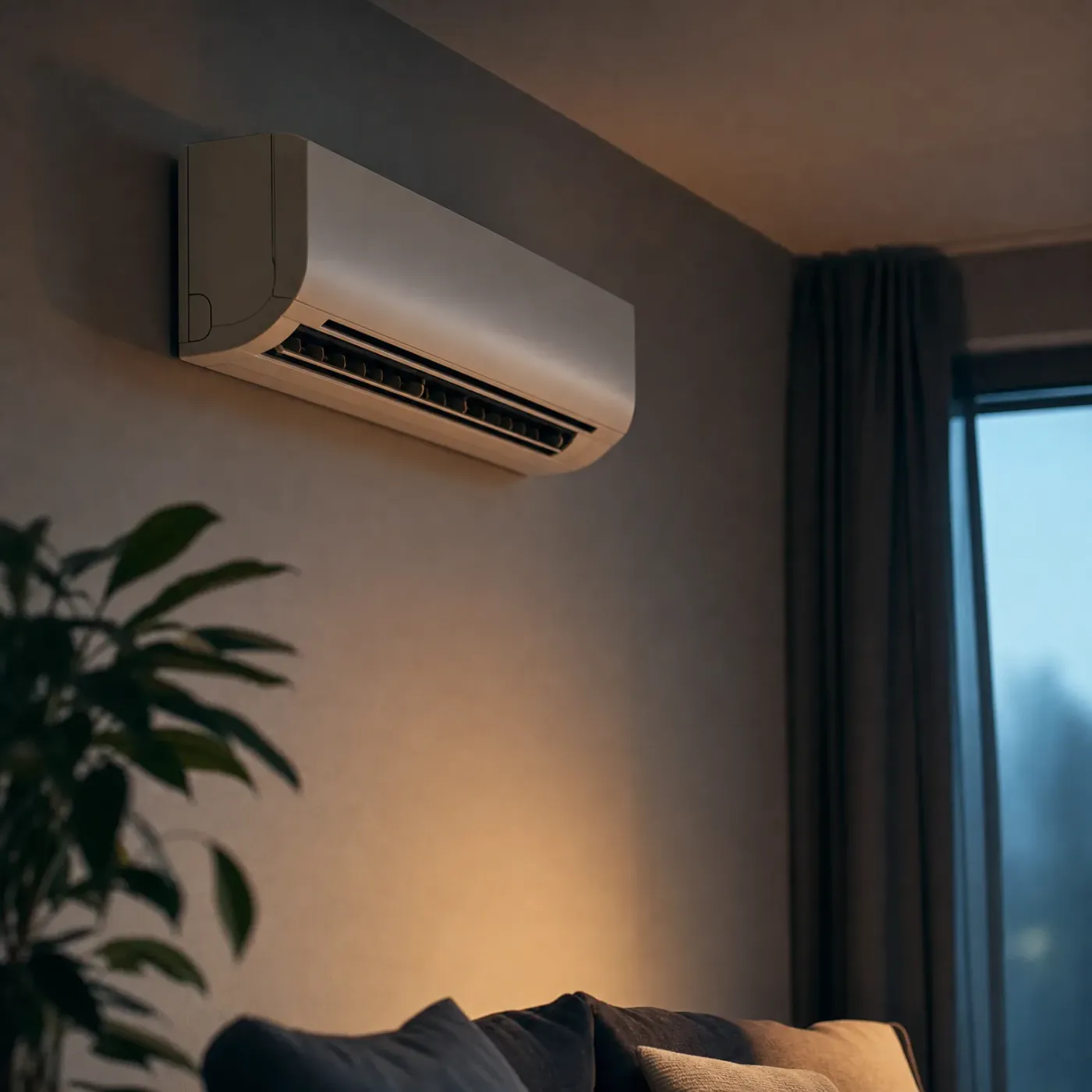
A steady light and a quiet hum mean the board has nothing to report. Air moves freely through the vents, and the case stays free of dust. This is the baseline worth knowing, so you notice when it changes.
Get matched with a mini split pro in Lancaster County
A blinking light on your mini split is it telling you something, usually a code for what's wrong, not just a random glitch. This page gets into what the blinking pattern can mean and what it doesn't. If you'd rather skip the guesswork, you can get matched with a contractor near Lincoln who can read the code and look at your unit directly.
Find my proA blinking light on your mini split is the unit flashing you an error code, usually counted out in a pattern like two blinks, pause, four blinks. The indoor head and the outdoor unit both have a control board that watches things like refrigerant pressure, the temperature sensors, and the drain, and when one of those readings falls outside what it should be, the board flashes a fault code instead of running blind. With your winters here getting down into real cold, a common one is the outdoor coil icing over and the defrost sensor flagging it. The exact count and the gap between blinks point to a specific problem, and the pattern differs by brand, so the number itself only means something once you match it to your model's manual or chart. What it means for you is simple: the mini split caught something on its own before it failed outright, and that code is the starting point for whoever looks at it next.




The light on your indoor head is not just telling you the unit is on. A separate light, or the same one in a different pattern, counts out a fault the control board has already caught. It blinks a number of times, stops, then starts the same count again. That pattern is the code, and a technician reads it before taking anything apart. The board behind that light is in constant contact with the outdoor unit over a signal wire, so a problem outside can show up as a blink pattern on the head inside your living room. Not every brand does this the same way. Some use one light with a timed rhythm, others flash two or three lights in sequence, and the meaning of three fast blinks on one system is not the same as three fast blinks on another. The board also keeps a memory of the fault, so even if the light has already stopped, the history is still there to pull. And if the blinking started right when the power came back after an outage, it may just mean the unit needs to be reset, not repaired.


Cooling runs June through September
Four months of sticky summer heat means the compressor and coils work hard enough to trip a fault code more than once.
Heat runs October through May
Eight months of cold push the outdoor unit through its lowest temperatures, right when a blinking light is hardest to ignore.
Power here costs 11.20 cents per kilowatt-hour
At 11.20 cents per kilowatt-hour, a unit cycling on a fault still runs up your bill while it struggles to keep up.
NOAA nClimDiv 1991-2020 · EIA-861 2025

A steady light and a quiet hum mean the board has nothing to report. Air moves freely through the vents, and the case stays free of dust. This is the baseline worth knowing, so you notice when it changes.

Dust has built up across the casing and packed into the louvers. That buildup blocks the sensors that watch airflow and temperature, and a blocked sensor is a common reason the light starts blinking instead of holding steady.


Explain the mini split problem once instead of to every shop in Lancaster County.
There's no charge for the request.
Lincoln winters push the outdoor unit hard. A mini split pulls heat from outside air even when it's cold, and the colder it gets, the harder the compressor and the outdoor coil have to work to keep up. That outdoor unit also carries its own board and its own fault light, separate from the one on the indoor head. If ice builds up on the coil, or the fan can't turn freely, the board logs it and the light starts counting it out. Checking the indoor head alone can miss a code that's only showing outside.
Not every blink pattern means a part has failed. Some codes point to something that corrects itself once cleared, like a brief power dip or a sensor reading that settled back down. Others point to wear that only gets worse: a weak run capacitor, a clogged drain line, a refrigerant leak. The board can't tell you which kind you have, only that something tripped it. That's why the same code on two different units can mean two different repairs, and why reading the pattern is the start of the diagnosis, not the end of it.


A blinking light on your mini split is the board's way of logging a fault, and the pattern it blinks in points to what that fault is. Write down the count before it stops, because that count is what a technician uses to know where to start looking. In Lancaster County, that fault often traces back to the weather doing its usual work. Summer heat here runs the compressor and coils hard enough to trip a code, and the stretch of cold that follows, from fall through spring, pushes the outdoor unit through the same kind of strain in the other direction. Sometimes the cause is simpler than a failing part. Dust packed across the casing or blocking a vent can cover the sensors that watch temperature and airflow, and a blocked sensor can set off a code with nothing actually broken. A steady light, with no blink at all, means none of this is happening. The board has nothing to report, and that's the baseline worth knowing so you notice when it changes.
None of that tells you which fault you have without someone reading the pattern in person. What it does tell you is that the blink is worth taking seriously and worth describing accurately. Instead of searching for a contractor on your own, calling around to ask who's available, and explaining the same blink pattern to each one you reach, you can answer once and get matched with someone who already knows what that pattern can mean before they walk in.
Skip calling shops to ask who repairs mini splits in Lancaster County.
