One indoor head, one outdoor unit
A mini split has fewer parts than a furnace and blower setup. The filters and the coil behind them are what a tune-up spends the most time on.

A mini split tune-up covers the same ground whether the system is running your AC in July or carrying your heat on a cold morning. A contractor cleans the indoor head's filters and coil, checks the outdoor unit's coil and fan, and looks at the refrigerant charge and the drain line. If the system does double duty as your heat, they'll check that it's defrosting properly, since a unit that ices over in cold weather won't put out heat until it clears. Electrical connections and the condensate drain get checked too, since a clogged drain can back up and drip into the house. None of this is urgent work on its own. It's what keeps a mini split running at the efficiency it was built for, instead of losing capacity a little at a time until a summer afternoon or a cold snap shows you the difference.


A mini split has fewer parts than a furnace and blower setup. The filters and the coil behind them are what a tune-up spends the most time on.
Your mini split carries the cooling when it's sticky out and can carry heat on cold mornings too. A dirty coil or filter slows it down either way.
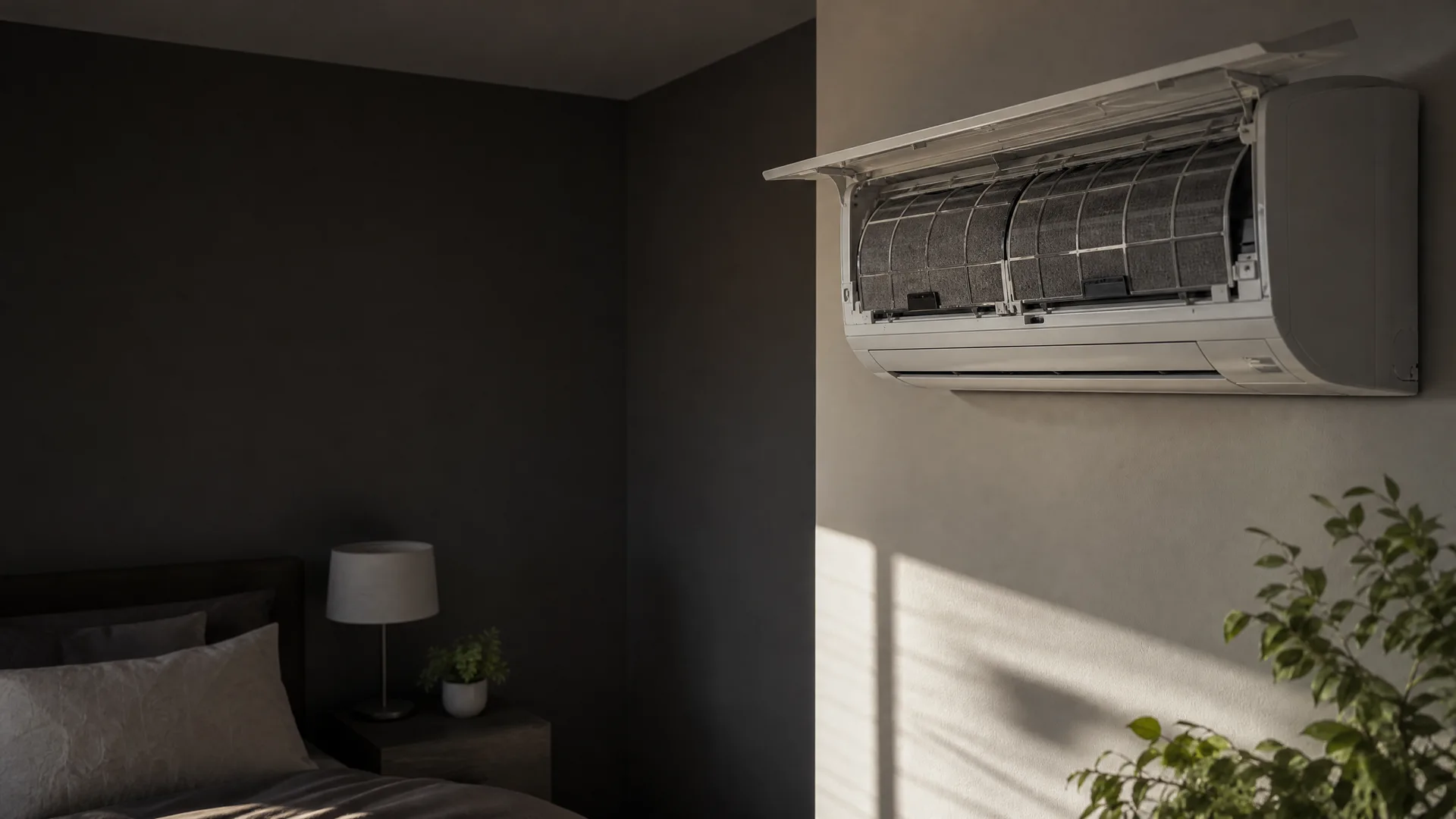
You pull the bedroom unit's front cover up on a Saturday in April and the filter screen underneath is grey with dust, matted down in patches where it's caught the worst of it. The window's open a few inches, first warm day of the year, and you'd only lifted the cover to see what was under there. The screen doesn't look like it's let much air through in a while. You can see the fins of the coil behind it, a little dusty too, catching the light from the window. Nothing's broken. The unit still runs when you turn it on. But standing there with the cover in your hand, you're already thinking about the first muggy week coming and whether this thing can keep up with it like this.


A gauge at the outdoor unit's service port tells a contractor the refrigerant charge, which matters because a mini split that's low on charge still blows air, just not cold or warm enough to keep up on the worst days. Inside, the drain line running from the indoor head gets cleared. It's a thin tube, and algae or dust can block it over a few years without you noticing anything until water shows up where it shouldn't. Behind the filter sits the blower wheel, a small caged fan that moves the air across the room. Washing the filter doesn't touch it, and a dusty wheel throws the airflow off balance even when the filter looks clean. Outside, the electrical connections at the compressor get checked and tightened. A loose one doesn't always trip a breaker, but it can make the compressor start and stop at odd intervals, which wears it faster than steady running would. The line set, the pair of refrigerant lines running between the two units, gets a look at its insulation, since gaps there let heat in during summer and let cold in during winter, making the system work harder than it should. Last, the outdoor fan motor gets checked by hand for play in the bearings. A motor that's starting to wear will often show a little side to side movement before it ever makes a sound, and catching it then means replacing a part instead of waiting for a breakdown on a July afternoon.




A mini split that's never been cleaned works harder to cool a room in July and harder to heat it in January, running longer to hit the temperature you set.
A mini split that's had a filter and coil cleaning moves the air it's rated for, in both directions, without running longer than it has to.


The pro who reaches out is licensed in Nebraska.
No charge to send it. You decide if you hire them.

This is a head that's been kept up. The casing's white, the vents are clear, and air moves through it without strain. A filter and coil cleaning keeps it pulling its full airflow whether it's cooling the room in July or heating it on a cold morning.

The casing's gone yellow and the dust on the front face has been sitting long enough to build up. That usually means the filter and coil behind it are in the same shape, and the head's been working harder than it should to move air through both.
Stand near the head and listen. If it's running longer than it used to, or you feel weak airflow where there used to be a strong push, the filter or coil is probably dirty. Look at the vents for a film of dust, or check under the casing for a musty smell, a sign the drain line is clogged and water is sitting somewhere it shouldn't. In summer this shows up as a room that won't quite cool down even with the unit running. In winter it's a bedroom that stays cool while the thermostat says otherwise. None of this breaks the system overnight, but it means it's pulling more power than it needs to, every day, to get you less comfort in return.

Summer dew points average 61°F across June, July and August where homes are in Nebraska, according to NOAA climate data. That's heavy, sticky air, the kind that makes a room feel warm even when the thermostat says otherwise. Your mini split has to pull that moisture out as it cools, and a dirty filter or coil slows that down. You'll notice it as a room that stays damp-feeling longer after the unit cycles off, or a head that runs and runs on a muggy afternoon without the air ever feeling as dry as it should.
NASA POWER T2MDEW county cells weighted by homes
You can see the indoor head easily enough, but the outdoor unit sits against the house or up on a pad, and you've probably never looked closely at what's going on with it. It's the half of the system doing the heavy lifting, moving heat in or out depending on the season, so it's worth knowing what a contractor actually checks when they get out there.
The outdoor unit's coil is a grid of thin fins, and it needs air moving through it freely to work. A contractor clears leaves, grass clippings and the fine cottonwood fluff that builds up on it, then checks that the fan spins freely and pulls air the way it's supposed to. They'll also check the refrigerant line running to the indoor head for damage, since a kinked or worn line affects the whole system. The charge itself gets tested at the service port, because low refrigerant shows up as weak cooling in July and weak heat on a cold morning alike. A unit with a clear coil and full charge moves heat the way it was built to, in either direction.
The indoor head's front cover comes off first.
Filters slide out and get washed clean of dust.
The coil behind the filters gets brushed and rinsed.
The drain line gets checked and cleared if it's slow.
At 12.05 cents a kilowatt-hour, running your mini split in both directions doesn't punish the bill the way it would somewhere pricier. A dirty filter or coil still makes the head work harder and run longer than it needs to, so a tune-up keeps you getting the benefit of that rate instead of losing it to strain.
EIA-861 2025 statewide residential average

That's the whole job. Clean filters, a clear coil on both the indoor head and the outdoor unit, and a look at the refrigerant line and the drain. Nothing about a mini split makes that work complicated, but it has to get done, in both directions, every year it runs your AC and your heat.
If you're past the point of checking the filter yourself and want someone who works on these systems to look it over, you'll be matched with a licensed contractor near you in Nebraska, one who sees mini splits in every season and knows which part on yours tends to go first. Just the one contractor calls, not a handful, so you're not stuck fielding bids from companies you didn't ask for.


There's no charge for the request.
A mini split that's cleaned before summer doesn't have to work as hard to keep up once the sticky days hit. Send the request now and a local contractor can get to the filters and coil before July asks more of them.