
Fix it yourself
You check the mode, swap the remote batteries, maybe clean the filter. Sometimes that clears it. If it doesn't, you're stuck guessing at a reversing valve or a sensor with no way to check either.
A mini split blowing cold air when you want heat usually means it's stuck in cooling mode or the mode setting got bumped, often by accident on the remote. Check that first. If the mode is right and you're still getting cold air, the problem is more likely with the unit itself: a reversing valve that isn't switching, a dirty outdoor coil, or a refrigerant charge that's too low to pull heat from outside air. That last one matters more in Nebraska than in milder places, since a mini split working to heat a home through a cold winter is already asking more of its refrigerant cycle, and a low charge shows up faster. A unit blowing cold instead of warm on a cold day isn't keeping up, and the longer it runs that way, the harder the compressor works for no heat at all.
Once the mode setting checks out, the reversing valve is the next place to look. It's what switches the system between heating and cooling by redirecting refrigerant flow. If it sticks in the cooling position, the indoor unit keeps blowing cold air no matter what the thermostat or remote says. This isn't something you can see or test without gauges, so it takes a technician to confirm.
Refrigerant that's low from a slow leak can also leave a mini split blowing air that feels cold or barely warm in winter. The system needs the right charge to move heat into the house, and even a small loss changes how well it does that. Nebraska winters make this one easy to notice fast, since the gap between cold air and the heat you actually need shows up within minutes of the unit running.
You've got the mode set right, the reversing valve looks fine, and the room already feels cool enough, but the unit keeps blowing cold air past the point where it should back off. In Nebraska, with gas heat handling most of the real cold and power cheap enough that nobody's shy about running the mini split, this usually comes up on mild days or in a room that doesn't need much help at all.
Every mini split has a temperature sensor, either in the indoor head or on the remote, that tells the system when to cycle off. If that sensor sits in a draft, near a window, or close to the unit's own airflow, it reads the room wrong and keeps calling for cooling long after the space is comfortable. A dirty sensor or a loose connection causes the same thing. This matters more on humid Nebraska days, when a mini split is also pulling moisture out of the air and running longer than the room temperature alone would suggest. A contractor can test the sensor against an actual room reading and recalibrate or replace it, which isn't something you can judge from the remote's display alone.
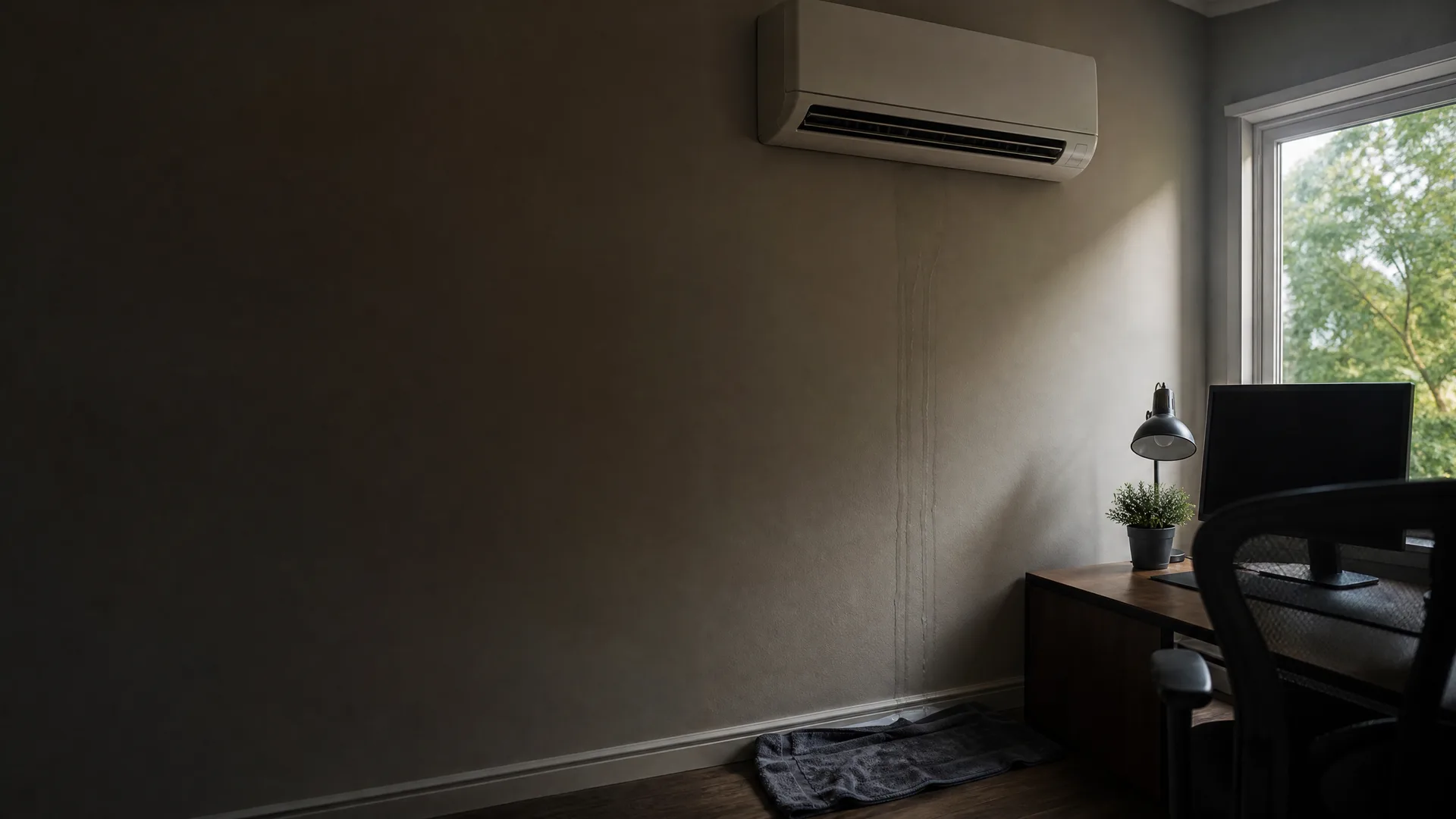
You're in your home office on a July afternoon, humidity thick against the windows, when you notice the wall under the mini split looks dark. A wet streak runs down from the indoor unit, pooling at the baseboard. You grab a towel from the hall bathroom and lay it on the floor under the drip. The unit is still running, air coming out cold, and you stand there a second trying to decide if this is something you let go until the weekend or something you deal with now. You've caught small things before they turned into bigger ones. This isn't a sound you can wait out. You find yourself wondering who in Nebraska actually works on these units, and whether you'll need to call around to find out.
A mini split that won't give up cold air in January is a different animal than one dripping water in July, but both mean something inside the unit isn't doing its job. Nebraska winters don't forgive a heat pump that's stuck. You can swap the remote's batteries and flip the mode a dozen times, but if the reversing valve or a low refrigerant charge is behind it, nothing you do from the wall will fix it. That takes a tech with gauges and the right parts on the truck. Most houses here run on gas furnaces, so a mini split acting up isn't usually a cold-night emergency, but it's still money going out through a system that isn't heating or cooling the way it should. Instead of searching around, calling a few places, and repeating the same story about cold air and a stuck valve to each one, you can hand that off. Tell it once, and a contractor who works on these systems in your area follows up.
Run a mini split through a Nebraska winter and it earns its keep against the gas bill, since power here is cheap and every degree it covers is a degree your furnace doesn't have to.
Run it stuck in cooling mode through that same January and it's just pushing cold air into a cold room while the furnace fights to keep up, costing you twice over for no heat at all.




You check the mode, swap the remote batteries, maybe clean the filter. Sometimes that clears it. If it doesn't, you're stuck guessing at a reversing valve or a sensor with no way to check either.
Skip calling around and explaining the same problem twice. A contractor who handles mini splits in your area reaches out to you directly to sort out what's going on.

If that mini split is what's heating a bedroom or a converted porch, a unit stuck blowing cold air leaves that room cold while the rest of the house, running on gas, stays fine. You might not notice for a day or two beyond "that room feels off," especially if nobody's sleeping in there yet. By the time you're reaching for a space heater, the unit has been running wrong for a while, cycling the compressor against a room it's cooling instead of heating.
Tracking down whether it's the reversing valve, a sensor, or something else means someone who can test the refrigerant circuit, not just check settings. Getting matched with a contractor who works on your unit's brand skips the part where you call three companies, describe the dripping or the cold air to each one, and wait to see who calls back with a quote first.


Summers here run sticky. NOAA puts the average summer dew point in Nebraska at 61°F, which is the kind of air that sits heavy even after the thermostat says the room is cool. A mini split that's stuck in cooling mode doesn't care that it's July and the air already feels damp enough. It keeps pulling moisture and pushing cold air, and the room can end up clammy instead of comfortable, with that dampness lingering on the walls or the floor near the indoor unit.
NASA POWER T2MDEW county cells weighted by homes


At 12.05 cents a kilowatt-hour, running your mini split isn't what's hurting you here. A unit stuck blowing cold air just wastes a few cents an hour while it fails at the one job you need it to do: heat that room.
EIA-861 2025 statewide residential average
Start with the remote. Check the mode setting, swap the batteries, clean the filter. None of that costs you anything and some of the time it's the whole problem. If cold air keeps coming after that, you're looking at a reversing valve stuck in the wrong position or a sensor that's failing, and neither one is something you can test from the living room. Someone has to open the unit and check the parts directly.
That's the point where this stops being a weekend fix. A reversing valve or a bad sensor needs a contractor with the tools to confirm which one it is, because guessing wrong means paying for a part that wasn't the problem. If this unit is the only thing heating a bedroom or a porch, that room stays cold until someone fixes it, even while the rest of the house runs fine on gas.
Getting matched with a contractor means you skip the part where you call around town, explain the same problem to three different people, and sit there sorting through quotes that don't match up. You describe it once, and a contractor who handles this equipment reaches out to you. Whatever's actually wrong inside that unit, mode glitch, stuck valve, or failed sensor, it gets found and fixed without you doing the legwork of finding someone qualified to look.





Describe your mini split job once, to one pro.
You're not committing to anything by asking.